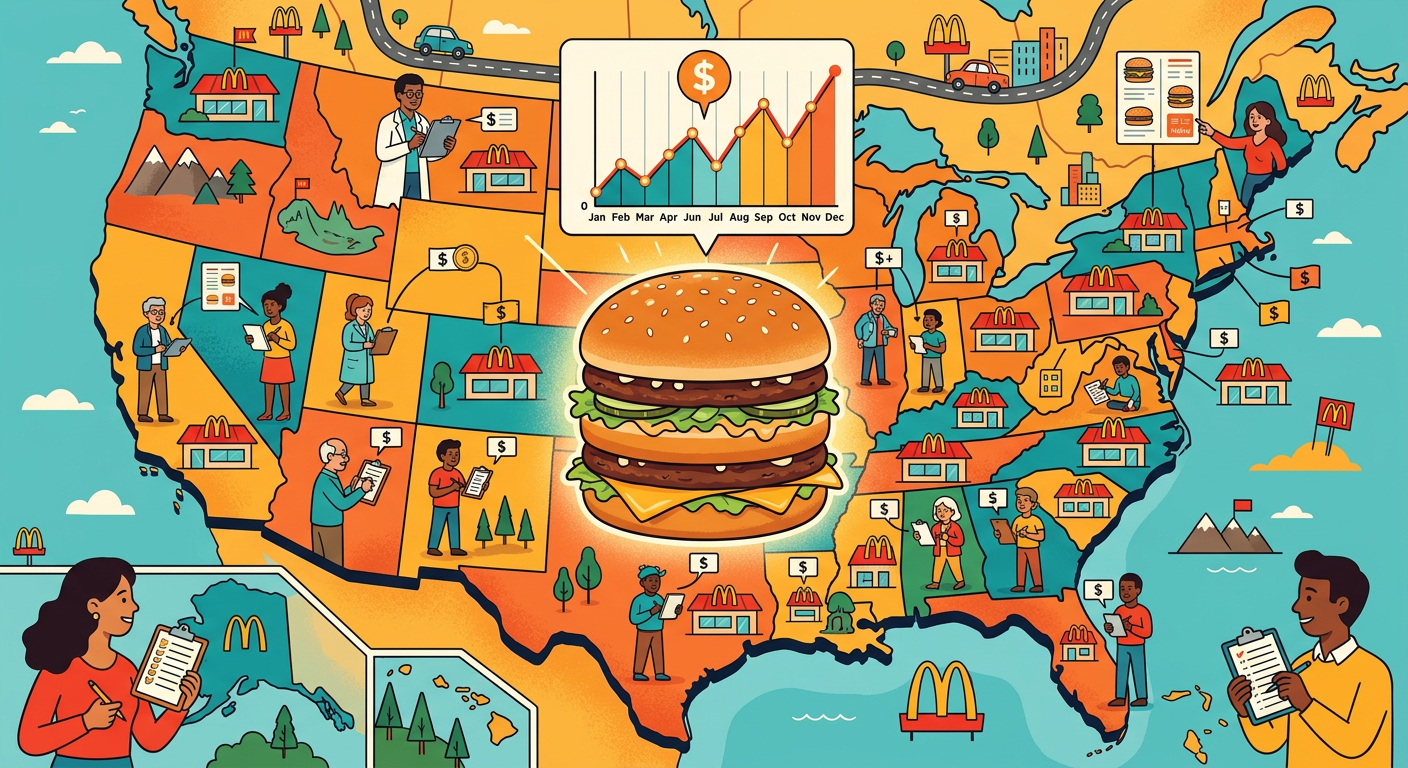
The Current National Average
Across all 9,259 zipcodes we tracked, the Big Mac averages $5.91. That's your baseline if you're wondering whether your local McDonald's is charging a fair price or pushing toward the high end.
This average reflects real menu prices pulled from locations nationwide, not promotional deals or app-only offers. When you walk up to the counter and order a Big Mac without any coupons, $5.91 is roughly what most Americans are paying right now.
The Price Spread: $3.99 to $9.50
The gap between the cheapest and most expensive Big Mac we found is $5.51—more than the cost of a budget Big Mac itself.
- Lowest price tracked: $3.99
- Highest price tracked: $9.50
- Total difference: $5.51 (138% markup from floor to ceiling)
That means someone paying top dollar is shelling out nearly 2.4 times what someone else pays for an identical sandwich. Same two all-beef patties, same special sauce, same sesame seed bun—wildly different price tags.
Why Big Mac Prices Vary So Much
McDonald's doesn't set one national price. Each franchise owner decides what to charge based on local conditions. Several factors push prices up or down:
- Real estate costs: Locations in high-rent areas need higher margins to stay profitable.
- Local minimum wage: States and cities with higher wage floors see those costs passed to menus.
- Competition density: Areas saturated with fast food options sometimes keep prices lower.
- Tourist and airport locations: Captive audiences often mean premium pricing.
A Big Mac at a highway rest stop or airport terminal almost always costs more than one at a suburban drive-thru. The product doesn't change, but the circumstances do.
What This Means for Your Wallet
If you're paying close to $3.99, you're getting one of the best Big Mac deals in the country. If your local price is creeping toward $9.50, you're at the extreme high end—and might want to check the McDonald's app for deals or consider a nearby location.
The $5.91 average sits almost exactly in the middle of the range, which suggests most locations cluster around that point rather than skewing toward either extreme. Still, the existence of that $5.51 spread means location matters more than most people realize.
We'll keep updating these numbers as prices shift. For now, $5.91 is your benchmark—anything significantly below that is a relative bargain, and anything pushing past $7 or $8 puts you firmly in premium territory for a fast food staple.